

By Omid Sobhani
In 2006, a man from Ghor city came to Herat city to work for months to earn money to buy a solar panel and antenna so that his wife could watch the famous Indian TV series ‘Tulsi’ on Afghan TOLO TV.
This simple desire for entertainment mirrors the changing landscape of Afghanistan over the years—a journey from strict media prohibitions under the Taliban’s first reign (1996-2001) to a time where media played a crucial role in shaping society. Even the Taliban began adapting its information strategy, effectively co-opting the new media environment, to advance narratives.
On the eve of foreign troops’ withdrawal, the escape of the Afghan president, and the abrupt dissolution of the army, the Afghan media was the last democratic stand surviving the Taliban’s return to power on August 15, 2021. Once a beacon of democracy and the West’s achievement in the country, it is crumbling with economic issues and restrictions by the Taliban.
RSF reports a 40% media closure in Afghanistan, with female journalists experiencing a 60% decline and over 90% losing jobs. More than half of pre-August 2021 media outlets closed. Since the Taliban’s rise in August 2021, Afghanistan lost nearly 60% of journalists, reducing media outlets by 39.59%. The critical situation impacts 76.19% of women journalists who lost their jobs.
The Taliban mandates media alignment with Islamic law, prohibiting criticism of leaders. “11 rules for journalists” by the Taliban restrict reports contrary to Islam. The Taliban has further restricted women TV anchors, instructing them to cover their faces with masks while on air.
Afghanistan is ranked 152 out of 180 countries on the World Press Freedom Index, reflecting an uncertain future for media and journalism. Despite high unemployment in the sector, the presence of media and journalists working in the country signals a promising commitment to the field, according to media personnel.
Keeping Journalism Alive
Media professionals say urgent international support is needed to safeguard the remnants of democratic values that persist within the country. “We are talking about 10 thousand journalists, and media professionals, and 70/80 percent of them are still in the country,” says Lutfullah Najafizada, former head of TOLO News, now leading Amu TV in Canada, highlighting the resilience of the Afghan media system amid tumultuous political landscape, stating, “None of the TV and media stopped their broadcasting while the Afghan president fled and the army dissolved. We must see this picture.” Najafizada raises a crucial question: “The question is now how to protect this.”
This comes as access to information remains a key hurdle reported not only by Afghan journalists but also by some foreign journalists who were banned from reporting in Afghanistan. In response, Afghan journalists call for advocacy to restore support for in-country media and ensure the flow of information.
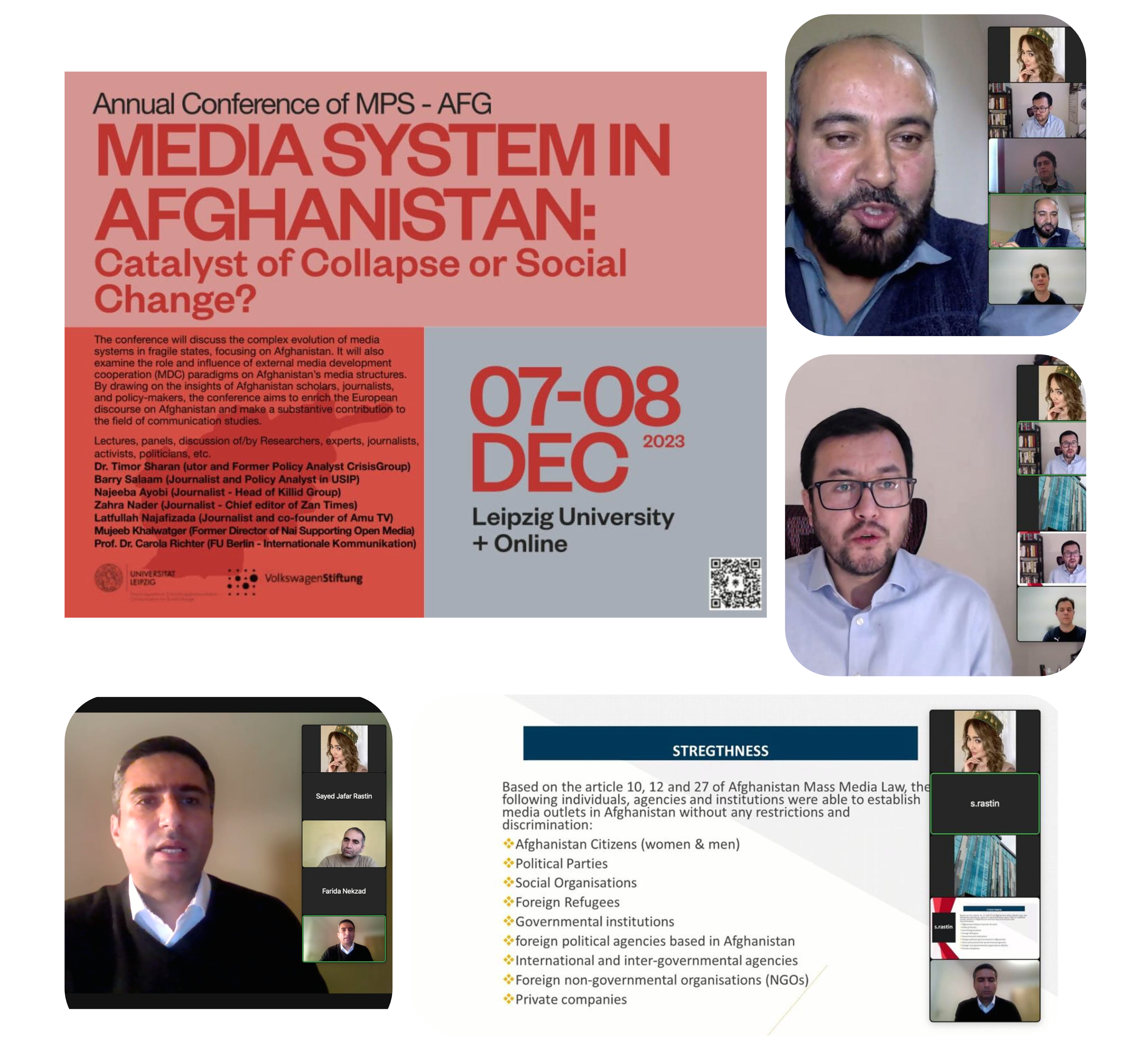
Speaking at a conference about the Media System in Afghanistan held by Leipzig University, Najafizada said to safeguard the continuity of Afghan media, a strategic focus on education and training is required as a response to the future bleeding wound of Afghan media, given the potential for a more restrictive environment that may come. “Training is important to protect themselves. Violence remains a significant concern, with over 200 cases of intimidation.”
He admired the efforts of journalists who continue to hold the Taliban accountable and address vital issues on TV programs about women’s rights. “As we speak, thousands are graduating from journalism schools across the country. We received over 500 resumes. It is a promising development also that these journalists want to stay in the field and push boundaries,” Najafizada reiterated, calling for attention to women journalists.
“Female journalists, facing limitations in attending journalism schools, require immediate attention, and finding ways to support them is our collective responsibility.”
With the fallout from the US-Taliban deal that brought the Taliban back to power, Afghan women journalists were disproportionately affected in the media sector. Out of 2,756, only 656 remain, with 84.6% working in Kabul, as reported by RSF.
Journalists Seek Jobs Despite Difficulties
Zahra Nader, the founder of Zan Times, a women-led media outlet based in Canada covering Afghan women’s issues under the Taliban since their takeover, highlights the plight of women in reporting women’s issues. According to her, the commitment of women journalists in Afghanistan is evident despite the pervasive threats.
A young female journalist working with Zan Times for over a year inside Afghanistan told Zahra,” Writing stories of other women gives me the purpose to say that even though the Taliban is trying to take our rights away, I was there reporting on the situation of what was happening in the absence of the media,” highlighting the determination of women in ensuring their voices are heard amid the hardships they face daily.
Zahra is having difficulties to ensure their safety and payment. She pointed out the lack of real support despite widespread acknowledgment by the international community. “We receive many requests from women journalists working in Afghanistan asking me ‘Can we work with you’ and I tell them the truth. If the situation changes, I will come to you,” she said, adding that it is getting difficult to continue the work without real support.
Setting up Zan Times with her savings initially, she underscores the urgent need of the international community for financial support and infrastructure for women working in Afghanistan.
Meanwhile, the Afghan economy shrank by 25 percent in the last two years, according to the latest report by the World Bank. According to media professionals, this situation is putting immense pressure on the media, especially with the recent imposition of Taliban restrictions. The ban on entertaining programs that once served a vital revenue stream for media outlets, has added to the financial strain.
The media faces a dual challenge: addressing economic sustainability amid shrinking revenue streams and continuing to provide accurate and timely information in multifaceted crises.
The economic aspect plays an important role, in finding the right mechanism to make the media financially independent, according to Abdul Qahar Jawad, a Professor at Kabul Journalism Faculty. He emphasized the demand for a shift towards sustainability, rather than relying on donors.
Jawad, however, envisioning the future of journalism students, recounts a disheartening scene where his students reacted to the sight of a previous journalism graduate selling Bolani on the streets of Kabul. “I told my students, let’s hope for the future, we pursue professionalism out of training and hoping for a good day to come,” he said, urging a collective effort to prepare for a more promising future.
Expressing optimism, Jawad encouraged his students to educate themselves and prepare for the brighter days ahead, calling for the need to leverage their capacity to ensure a well-received outcome.